01
Learn
Start with category-level education, not pressure.
Before care decisions
We help people evaluate non-surgical and biologically oriented health options with clearer mechanisms, evidence context, uncertainty boundaries, and standard-care perspective — so decisions can be made with less noise and less pressure.
Read the core explainerEducation-first. Clinician-aware. No cure claims. No outcome guarantees.
What NSH does
Many modern health ideas live in a difficult middle space — somewhere between unrealistic promises and total dismissal. NSH helps people evaluate that space with clearer mechanisms, evidence context, uncertainty boundaries, standard-care perspective, and questions for licensed clinician conversations.
What is it, how is it believed to work, and what category does it belong to?
What is known, what remains uncertain, and where should claims stop?
What should you ask a licensed clinician before moving forward?
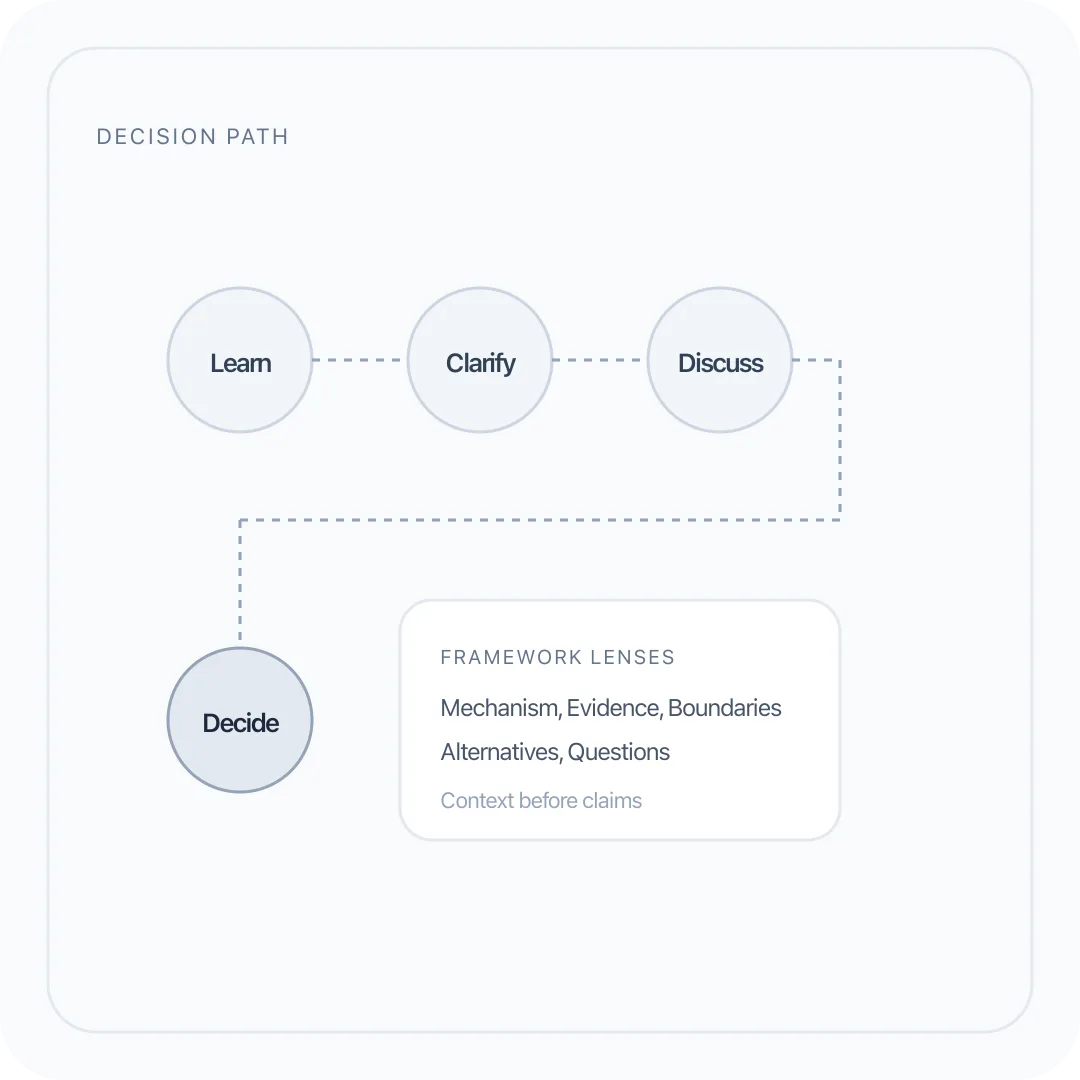
The NSH decision sequence
Better decisions usually come from moving through the process in order, rather than jumping directly to intervention.
Start with category-level education, not pressure.
Identify what is known, what is uncertain, and what applies generally versus clinically.
Bring better questions into a licensed clinician conversation.
Make a more informed choice with less noise and less urgency.
Our framework
Clarity before intervention.
NSH uses a consistent framework to help people evaluate non-surgical health options without overstatement.
Claims do not get to lead. Context does.
Mechanism
How is this believed to work?
Evidence
What level of support exists?
Boundaries
What should not be claimed?
Alternatives
What standard-care or lower-risk options should be considered?
Questions
What should a licensed clinician help clarify?
Read next in the library
The homepage sets the frame. The docs and blog explain how that frame is used in practice.
Evaluation framework
Start with the framework
Apply the full review model before treating any option or article as complete.
OpenCore explainer
Read the biological model
Use the explainer when a conceptual model helps after the framework is clear.
OpenEditorial standards
See how the filter is applied
Review how mechanism, evidence, and uncertainty are separated from marketing language.
OpenAreas we help people understand
NSH is modality-agnostic. We help people understand a range of non-surgical health options and where each may or may not fit.
These categories are educational. They are not treatment recommendations, and they do not replace evaluation by a licensed clinician.
Non-surgical does not mean anti-surgery. It means understanding options, evidence, uncertainty, and standard-care context before escalation.
Diagnostics as decision context
Biomarkers, imaging, and other diagnostic tools can be part of a health conversation, but specific results should be interpreted by qualified clinicians. NSH organizes general questions around diagnostics: what they measure, what they do not measure, and how they fit into a broader discussion.
Learn how to think about diagnosticsNSH does not diagnose conditions or interpret personal lab results outside an appropriate licensed clinical pathway.
Optional clinician conversations
When appropriate, NSH may help orient people toward a clinician-led conversation designed to clarify questions and appropriate next steps. Diagnosis, candidacy, treatment selection, and medical recommendations belong to licensed providers.
Explore careBoundaries matter
For clinicians and partners
NSH is exploring aligned relationships with clinicians, clinics, diagnostic partners, and health organizations that share a conservative, education-first posture. Clinical providers remain responsible for diagnosis, candidacy, treatment selection, and medical judgment. NSH supports education, patient orientation, language discipline, and decision-support infrastructure.
Before choosing any non-surgical health option, understand the mechanism, evidence, uncertainty, alternatives, and questions worth asking.
Start with the frameworkEducation list
Occasional mechanism-first notes explaining how emerging health ideas are studied, debated, and evaluated.